

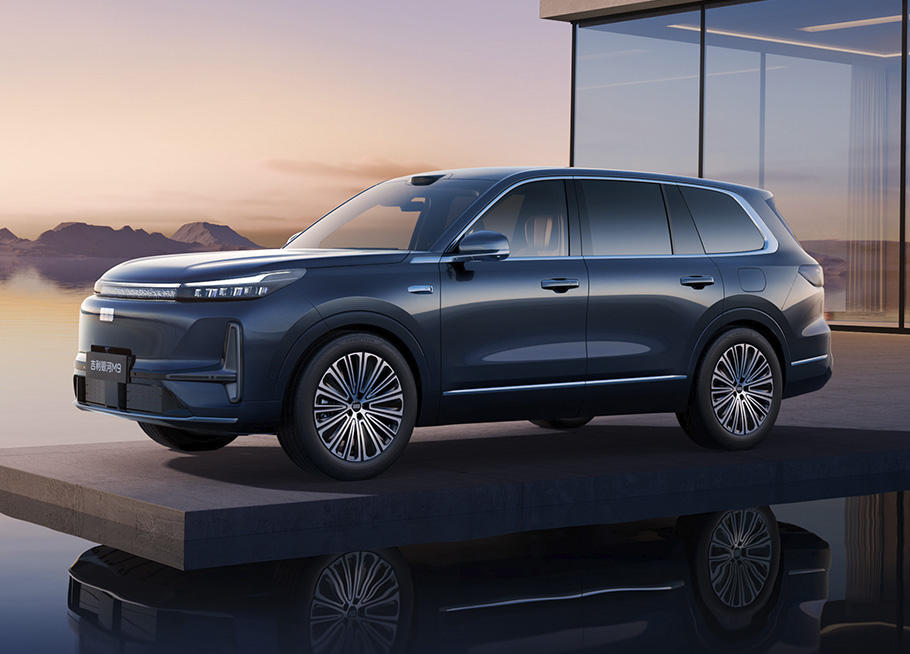
Geely Galaxy M9 is a large six-seat flagship crossover of the Galaxy family, built on a hybrid architecture with an emphasis on electric drive. The model plays in the top league in size and technology, yet attacks the market with a price below the «classic» premium players. The focus is long range without stress, a quiet cabin, advanced driver assists and suspension comfort — exactly what defines a «family flagship» in 2025.
An important part of the M9’s DNA is a practical PHEV: in the city you drive «on electricity», while on highways the ICE steps in, turning the car into an «anti-range-anxiety» device. Another plus for the M9 is the familiar fueling infrastructure and a fast-growing charging network in key regions. Altogether this makes the car a convenient tool for everyday life, not just a showroom novelty.
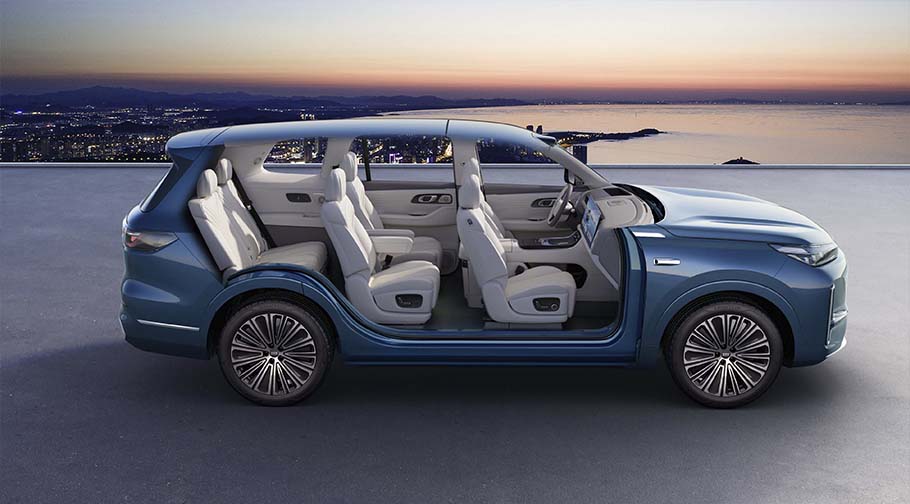
Geely Galaxy M9 concept
The M9’s idea is simple: give the user the «size, quietness and tech» of big hybrid SUVs without sending the price into orbit. Hence the three-row layout for 6 seats, body length of 5205 mm, wheelbase of 3030 mm and emphasis on second/third-row comfort. It’s an obvious rival to «long-wheelbase» classmates, but with a more aggressive pricing strategy.
The technical foundation is a hybrid platform with a highly efficient ICE working together with one or more electric motors. In urban use the car runs mostly on electricity, while the ICE acts as a generator and/or engages under load. On long trips the powertrain holds pace steadily, saving fuel and keeping the acoustic background quiet.
Inside, the M9 aims for «smart quietness»: multi-layer glazing, well-thought-out wheel-arch insulation, and adaptive chassis control systems. The cabin is formally «high-tech», but the interfaces and voice scenarios are designed not to distract from driving. It’s a car that tries to be unobtrusive and predictable in everyday life.
Sales start and prices
Pre-sales have been announced for the Chinese domestic market: the price corridor is set at 193,800–258,800 yuan (≈ $27–36 thousand, indicative) depending on version and battery. In China the final official list price at launch often comes a step below the pre-sale figures, but the basic range already shows the positioning — a «big hybrid» at a mid-size crossover price.
The lineup is a staircase: several trims with different batteries and drivetrains. Lower versions target those who mainly drive in the city and charge at home/at work. Upper versions are aimed at intercity travel, year-round active use and a desire for the full set of assists and comforts.
It’s important to understand: the M9 is a global product, but initial supply and demand validation traditionally happen in China. Overseas markets are added step by step, and timing and option packs depend on local certification and the distributor’s strategy.
Specifications
The powertrain offers two battery packs: 18.4 kWh and 41.46 kWh. Accordingly, the claimed electric range is up to 100 km or up to 230 km by «lenient» test cycles (for everyday mixed use, apply a quick «−15–20%» rule of thumb). The maximum combined cruising range with a full tank and a charged battery is up to ~1500 km.
The top specification delivers a quoted 0–100 km/h in 4.5 s and peak output up to 640 kW with about 1165 N·m of torque. Even mid-range versions feel confident: electric motors close gaps instantly in maneuvers, and power electronics smooth out the jerky rhythm of city driving.
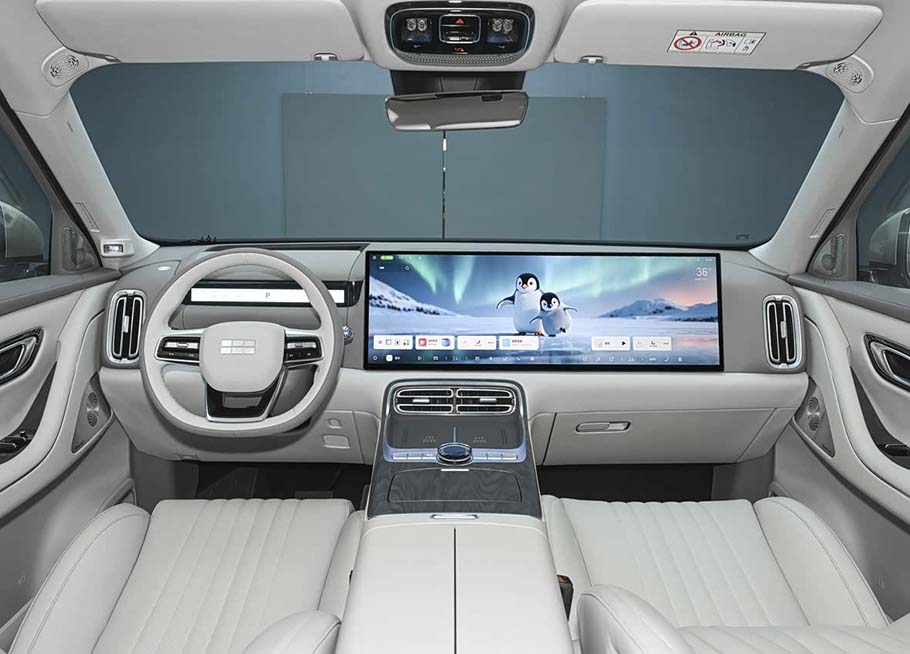
The cabin features a modern digital cockpit with a voice assistant and polished scenarios (navigation, climate, media, charge/efficiency). Driver assists are at an advanced level: adaptive cruise, lane keeping, automatic lane change and «extended» scenarios for traffic and highways.
Power
Top version: 640 kW — that’s roughly ≈ 870 hp (PS) or ≈ 858 hp (SAE).
Base and mid trims have lower total output (the manufacturer details each step as the model reaches the market), yet the throttle character remains «electric»: quick pedal response and a smooth, shift-free pull.
Trims
100 km EV, 2WD. The city-centric combo: lower price, sufficient «electric radius» for daily routes, and a full set of essential assists and media scenarios. Target audience — those who charge at home or work and rarely go long-distance.
230 km EV, 2WD. For those who live «on the plug» and drive a lot around town/suburbs. The larger battery lets the ICE engage less often and noticeably saves fuel. On highways it behaves like a classic hybrid with ample range.
«Long battery» + AWD. Configurations for regions with harsh winters/terrain and for fans of the full «tech basket». Here the crossover shows character: swift launches on slippery surfaces, stable cornering lines and confidence on broken pavement.
Chassis and comfort
The key to the M9’s character is its adaptive chassis. The two-chamber air suspension can vary volume and stiffness to keep the body composed while «inhaling» small bumps. Paired with electronically controlled dampers, it offers a wide range of settings: from a relaxed «city carpet» to taut highway composure.
Predictive algorithms work like «reading the road»: the electronics prepare the suspension in advance for seams, manholes and waves. As a result, the parasitic «after-bump bobbing» disappears and the wheel no longer demands constant micro-corrections. You feel it already at 60–80 km/h on familiar «undulations» — where you used to catch the body, the car now calmly returns to level.
Acoustic comfort is supported by multi-layer glass and thorough isolation of tire roar. In a large body this stands out: second-row passengers speak in half-voices even on rough asphalt, while kids keep sleeping instead of waking to «gravel in the arches».
Comparison: Geely Galaxy M9 vs. Li Auto L9
Class and layout: both are full-size 6-seat SUVs with three rows. Dimensions are close: the M9 is about 5205 mm long (wheelbase 3030 mm), the L9 — around 5220 mm (wheelbase about 3105 mm). Both target family trips with an emphasis on second-row comfort.
Powertrain: the M9 is a plug-in hybrid (PHEV) with two battery options (18.4 and 41.46 kWh) and, in top form, a distributed three-motor AWD; the quoted 0–100 km/h is as low as 4.5 s. The L9 is an extended-range EV (EREV) with an ICE generator and two electric motors (AWD); typical acceleration is about 5–5.5 s to 100 km/h.
Power: as a reference, the M9’s top trim peaks at up to 640 kW (≈ 870 hp PS / ≈ 858 hp SAE). The L9’s combined output is lower (two-motor scheme) but sufficient for confident acceleration and overtakes; its focus is on torque and ride smoothness.
Electric range and total range: the M9 claims up to 230 km CLTC on electric power and a total range of ~1500 km. The L9 offers roughly 175–220 km CLTC (depending on version and year), with 1000+ km combined. Both cover the «city on electricity + long trips without stress» scenario.
Suspension and comfort: both use air suspension with adaptive dampers. The M9 adds predictive algorithms («magic carpet») to smooth out bumps. The L9 is known for soft composure and high-speed stability; that «home-like» second-row comfort is its strong side.
ADAS and electronics: the M9 features the G-Pilot assist suite (with lidar on top trims) and an AI cockpit. The L9 offers proprietary AD packages (higher trims with lidar and powerful chipsets), plus a mature ecosystem and broad service network in its home market.
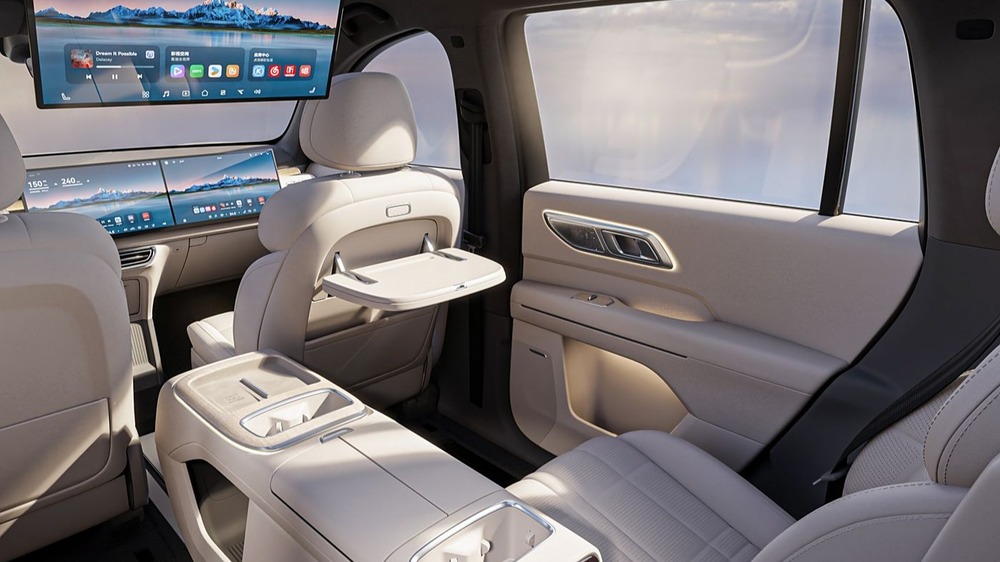
Interior and amenities: both provide 6 seats with second-row captain’s chairs, rich multimedia and attentive noise insulation. The M9 bets on «quietness + AI scenarios», while the L9 traditionally excels with a «cinema» experience for passengers and well-polished interfaces.
Price and value: the M9’s pre-sale range is 193,800–258,800 yuan (≈ $27–36 thousand). The L9 is noticeably more expensive: usually 400,000+ yuan (depending on year/trim). The M9’s advantage is «size and tech for half the price»; the L9’s strengths are reputation, residual value and a well-oiled dealer network.
Takeaway: the M9 is about an aggressive price-to-tech ratio in a full-size format; the L9 is about product and infrastructure maturity. Both are strong six-seat family SUVs; the choice depends on budget and priorities: saving money with «flagship» features (M9) or maximum ownership predictability (L9).
Geely Galaxy M9 in Russia
As of this writing, an official launch of the M9 specifically in Russia has not been announced. The brand is actively expanding exports and staging international showings, but local certification and specs depend on the distributor’s strategy and economic conditions. Typically, parallel-import deliveries appear first, followed by ramp-up of service infrastructure at major dealer groups.
If you are considering the M9 in the foreseeable future, evaluate servicing issues soberly: parts availability, software updates, diagnostics for assists and the hybrid system. On the other hand, the supply geography for Geely components in the region is expanding, and hybrid-service expertise has already formed on related models — which reduces ownership risks.
The «wait for official deliveries» scenario remains valid: you get transparent warranty, predictable software updates and clear resale liquidity. The «buy earlier via import» scenario suits those who need the size and tech now and are ready to invest in choosing a supplier and inspecting the vehicle.
In a nutshell
Geely Galaxy M9 is a six-seat PHEV SUV, 5.2 m long, with up to 230 km of electric range, up to ~1500 km total range, and a pre-sale price of 193,800–258,800 yuan (≈ $27–36 thousand). The arsenal includes adaptive air suspension, advanced driver assists and a quiet cabin. For families it’s a rare mix of «space and distance» at a mid-size crossover price. For the market it’s a signal that a «big hybrid» is no longer synonymous with «very expensive» by default.
FAQ
When did sales start and how much does the Geely Galaxy M9 cost?
Pre-sales for the Chinese market are open with a declared range of 193,800–258,800 yuan (≈ $27–36 thousand). The final official MSRP often ends up slightly below pre-sale figures, but the price order is already clear.
What batteries and ranges does the M9 have?
Two options: 18.4 kWh and 41.46 kWh. Electric range is up to 100 or 230 km by «lenient» cycles. The combined range with a full tank and a charged battery is up to ~1500 km.
Will the Geely Galaxy M9 be officially sold in Russia?
No official launch has been announced at the time of publication. The likely path is parallel import first, then, if demand and strategy align, local deliveries with dealer support.